בתוך הופעה של להקת קאברים של פינק פלויד, איך Echoes משחזרת את החוויה החיה
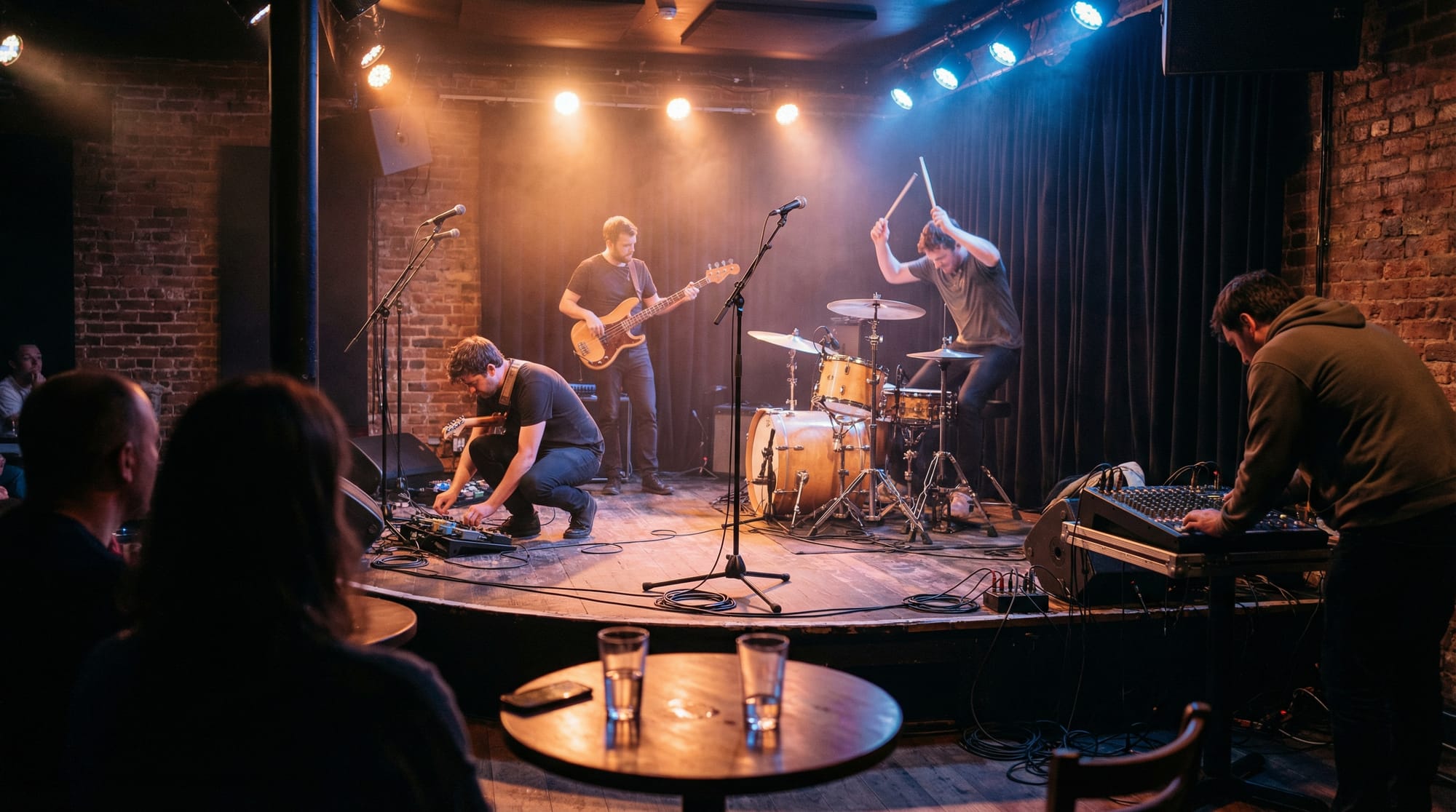
p>Five minutes before the lights went down, the room had that restless pre show hum, the kind that makes you check your ticket twice even though you already know where you are. People were taking last sips, scanning the stage, and pointing out little clues like they were solving a mystery. There was a circular screen at the back, dark for now. A neat line of instruments waited under a low wash of blue. Someone behind me said, almost reverently, “If they do it right, you forget it is a tribute.”
Then the house dropped into near darkness. A single pulse of sound arrived, not loud yet, just present, like the first heartbeat of a familiar record. The crowd stilled in the way an audience only stills when it recognizes a moment. When the full band came in, the punch was not just volume, it was depth. It was the sensation of air moving, of reverbs and delays arriving from exactly the right places, of a mix that felt three dimensional. For a second, it was easy to understand why people travel for shows like this. You are not attending a cover set, you are stepping into a carefully built illusion that honors a very specific kind of rock theater.
That is the promise of Echoes, Pink Floyd Tribute Show, one of the world’s leading Pink Floyd tribute bands. Founded in 2003, Echoes exists for listeners who want the iconic sound and live experience of Pink Floyd’s legendary concerts, not as a vague reference, but as a detailed reconstruction. Their performances range from hit compilations to full album tributes, concept shows, and collaborations with renowned musicians and productions. The goal remains consistent, to deliver stunning visuals and high fidelity sound in a way that feels incredibly close to the original.
Why the Pink Floyd live experience is so hard to recreate
Pink Floyd is not simply a band you listen to, it is a band you inhabit. Their best loved live moments were built on tension and release, long arcs of atmosphere, and sound design that functions like a landscape. Recreating that in a club or theater is difficult for three reasons. First, the parts are deceptively specific, tones, delays, modulation, and the way instruments sit together in the mix matter as much as the notes. Second, the material includes dynamic extremes, whispers that need to feel intimate and explosions that must stay clean. Third, the show is an audio visual event, with cues that need to land on time to make the audience feel the narrative.
Echoes approaches that challenge like a production team. The band is the visible center, but the experience is built by arrangements, gear choices, sound engineering, lighting, and video. The result is not a generic rock show with a few Floyd songs, it is a convincing, full scale tribute show.
Starting with the sound, tone before volume
The most immediate difference between an ordinary cover band and a serious Floyd tribute is how the guitars, keys, and vocals are voiced. It is not enough to play the right chords. The emotional imprint of songs like “Comfortably Numb” or “Shine On You Crazy Diamond” lives in the texture, the sustain, the space between notes, and the way a phrase blooms into the room.
Echoes builds tones that mirror the eras Pink Floyd traveled through, from early psychedelic color to the later, bigger stadium sheen. That means shaping the guitar sound to sit in the same harmonic range as the records, using delays that repeat at musical intervals, and keeping modulation effects subtle enough to feel natural. It also means that the keyboards and synth textures are treated as foundational, not decorative. In Pink Floyd’s world, keys often function like weather, creating the atmosphere the band moves through.
Vocals are approached with similar care. Floyd material demands clarity and character without theatrical over singing. The delivery has to feel grounded, almost conversational at times, and then rise to those unforgettable choruses. Getting that right is as much about restraint as power.
Setlists that tell a story, albums, eras, and contrasts
Part of Echoes’ appeal is the range of possible shows. Some nights are curated journeys through hits, others are full album tributes that let fans experience a record as a single arc. That matters because Pink Floyd albums are structured experiences, not just collections of tracks. When an album is performed in sequence, the audience is pulled into a narrative rhythm, the transitions and reprises make sense, and the emotional payoff hits harder.
Echoes’ setlists cover the most beloved albums, including “The Dark Side of the Moon,” “Wish You Were Here,” and “Animals.” You will also hear classics such as “Comfortably Numb,” “Shine On You Crazy Diamond,” and “Another Brick in the Wall.” The band does not stop there. They reach back to Syd Barrett era tracks like “See Emily Play,” and they include later works from David Gilmour’s leadership period, including “Learning to Fly” and “Sorrow.”
That wide scope is crucial because it replicates how fans remember Pink Floyd, not as one fixed sound, but as a band that evolved. The early material carries a playful, kaleidoscopic energy. The mid era albums lean into conceptual weight and studio craft. The later material expands into bright, soaring spaces. Seeing those chapters in one night can feel like flipping through a well worn photo album that still surprises you.
Transitions and pacing, where the magic often lives
Many bands can play individual songs well, but Pink Floyd is built on transitions. The space between tracks, the lingering drones, the heartbeat pulses, and the way one theme foreshadows another are part of the composition. Echoes treats those moments as first class material, not filler. The pacing is designed to keep the audience inside the spell.
This is where the production mindset shows. There is a sense of cues and timing, of letting certain notes hang long enough for the room to breathe, and then bringing in the next part smoothly. When it is done right, the audience stops thinking in song titles and starts thinking in moods and scenes.
High fidelity sound, what “close to the original” really means
When people say Echoes sounds close to the original Pink Floyd concerts, they are usually reacting to a few concrete elements. One is separation. Each instrument has its own space, so the mix never becomes a blur. Another is depth, meaning the sound feels layered from front to back. A final element is dynamic control. Quiet passages remain intelligible, while loud sections stay powerful without harshness.
Achieving that requires discipline on stage and careful work behind the scenes. The band’s arrangements leave room for the details to be heard. The sound reinforcement supports the natural tone rather than flattening it. And the overall volume is used as a tool, not a substitute for impact. In a tribute context, this kind of engineering is not a luxury, it is the main instrument.
Lighting and visuals, building the theater of a Floyd night
People often underestimate how much of Pink Floyd’s identity lives in the visuals. The concert experience is not merely listening to great songs, it is watching light and image transform the music into a world. Echoes leans into that tradition with stunning visuals that support the emotional shape of each piece.
The most effective visuals do not distract. They underline. A slow shift of color can make a chord change feel like sunrise. A well timed burst of brightness can make a chorus feel like release. The circular screen, the projections, and the lighting cues work together to guide attention and heighten the narrative, especially during longer passages where the music is meant to be immersive rather than busy.
Because Echoes performs different formats, from hits to full albums and concept shows, the visual design can be tailored. A compilation set might emphasize iconic imagery and recognizable moments. A full album performance can treat the visuals as a continuous arc, paying respect to the album’s themes and mood. Collaborations with musicians and larger productions can expand the palette even further, turning the stage into a moving canvas.
The musician’s challenge, precision with feeling
Covering Pink Floyd is a balancing act between faithful replication and living performance. If you imitate too rigidly, it can feel like a museum exhibit. If you stray too far, it stops feeling like Floyd. Echoes aims for a middle path, honoring the arrangements while keeping the humanity of a real band on a real night.
That means the lead lines need to land with the right phrasing, but also with the urgency of a performance. The rhythmic foundation needs to stay steady, especially through longer builds where the temptation is to rush. The keyboards must remain musical, not just accurate. And the vocals must carry the emotional weight without turning into caricature.
When all of that aligns, the show becomes more than a greatest hits recital. It becomes a shared memory making event, a room full of people collectively remembering why these songs mattered in the first place.
From Syd to Gilmour era, honoring the full timeline
One of the most satisfying aspects of an Echoes show is hearing how the band navigates the shifts across decades. Early Syd Barrett era material has a different spirit than the grand, polished later period. When Echoes plays a song like “See Emily Play,” the sound opens into a brighter, more whimsical texture. When they move into darker conceptual territory, the tones tighten, the groove becomes more insistent, and the visuals often sharpen to match.
Later period songs such as “Learning to Fly” and “Sorrow” bring their own emotional register. There is a sense of forward motion and clarity, with guitar textures that feel expansive. Including these songs acknowledges that Pink Floyd’s legacy did not freeze in one year. It continued to develop, and fans carry attachments to different eras. A tribute show that embraces that range feels more complete, and more welcoming to audiences who discovered the band through different entry points.
What the audience brings, why this music still gathers people
A Pink Floyd tribute audience is often wonderfully mixed. You will find listeners who saw the originals decades ago standing next to people who found the music through streaming, film, or a parent’s record collection. In that crowd there is a quiet agreement, everyone is here for the same reason, to feel something that is both personal and communal.
Echoes benefits from that shared intention. When the opening notes of a beloved track arrive, you can sense the room lean in. People do not just sing along, they listen. They watch. They wait for the solo they have carried in their head for years. They react to the same moments, the lyrical turns, the sudden silence, the release into a chorus. The tribute becomes a meeting place where individual nostalgia turns into collective experience.
What to listen for at your first Echoes show
If you want to understand how Echoes recreates the live experience, focus on a few details rather than trying to compare every second to a studio recording.
- Dynamics: Notice how quiet sections stay clear and intentional, and how loud passages stay clean and controlled.
- Space: Listen for delays and reverbs that create width and depth, and for how instruments leave room for one another.
- Transitions: Pay attention to how songs connect, and how sustained sounds, drones, and cues maintain immersion.
- Visual timing: Watch how lighting and projections shift with musical sections, especially during buildups and releases.
- Era changes: Notice how the band adjusts tone and mood when moving from early psychedelic material to later, more modern tracks.
The point of a tribute show, not replacement but re entry
No tribute band can literally time travel. The original Pink Floyd concerts were products of their time, their technology, and a singular cultural moment. Echoes does not try to pretend otherwise. What they offer is re entry, a way for fans to step back into the sonic architecture and visual theater that made those songs legendary, delivered with enough care that it feels truthful.
Walking out after the final notes, you do not leave thinking about technical details, even though they were everywhere. You leave with that specific post show quiet, the one where your ears are still ringing gently and your mind is replaying images like dreams. You might hear someone say again, “You forget it is a tribute.” And in a sense, that is the highest compliment. Echoes recreates the live experience by taking it seriously, as music, as craft, and as an immersive story you get to live in for a few hours.